




• Everyone Talks About U.S. Debt But Europe May Be in Worse Trouble


    America’s debt problem is impossible to miss. Federal debt has crossed $40.08T, another $1.9T deficit is expected this fiscal year and the 30-year Treasury yield is around 5.25%, its highest since 2007.


    Yet the next Western debt crisis may begin across the Atlantic.


    Washington has advantages that buy it time. The United States issues the world’s principal reserve currency, collects taxes through one federal government and sells debt through one enormous Treasury market. It can attract foreign capital and push part of the cost abroad. That does not make $40T harmless, but it can delay the reckoning.


    The eurozone has no comparable safety valve. It has one currency and one central bank, but 20 governments issuing their own debt, running separate budgets and answering to different voters. The ECB must set one monetary policy for economies with very different debts and growth rates.


    France shows why this is dangerous. Its 10-year bond yield has risen to about 4.15%, its highest since 2008 and now slightly above Italy’s. The European Commission expects a 5.1% French deficit this year and public debt near 120% of GDP by 2027. The problem can no longer be blamed on Greece or another small southern economy. France is the eurozone’s second-largest economy and one of the states meant to support rescue mechanisms for everyone else. If its debt starts trading like the old European “periphery,” the line between rescuers and rescued begins to disappear.


    Germany offers little comfort. Its 10-year yield is near 3.3%, a 15-year high, while its industry remains weak. Europe’s two central powers are paying more to borrow just as Brussels prepares another spending surge.


    The EU plans to mobilize up to €800B for rearmament. Member states must also finance ageing populations, expensive energy, social programs and support for Ukraine. Budget cuts provoke resistance. More borrowing raises yields. ECB intervention places more national debt risk onto the shared monetary system.


    The United States can abuse the dollar’s global role for longer. Europe may hit the wall first because it carries heavy debts without a genuine federal state standing behind them. One central bank cannot reconcile every national budget forever. So yes, America’s debt matters. But the louder surprise may come from a European Union that spent years presenting itself as the responsible alternative. Washington has a dangerous debt problem. Europe has the same problem inside a system poorly designed to survive it.


    No sympathy is required. Both created this predicament through wars, sanctions, subsidies and promises they can no longer finance cheaply. Now we get to see which model breaks first.
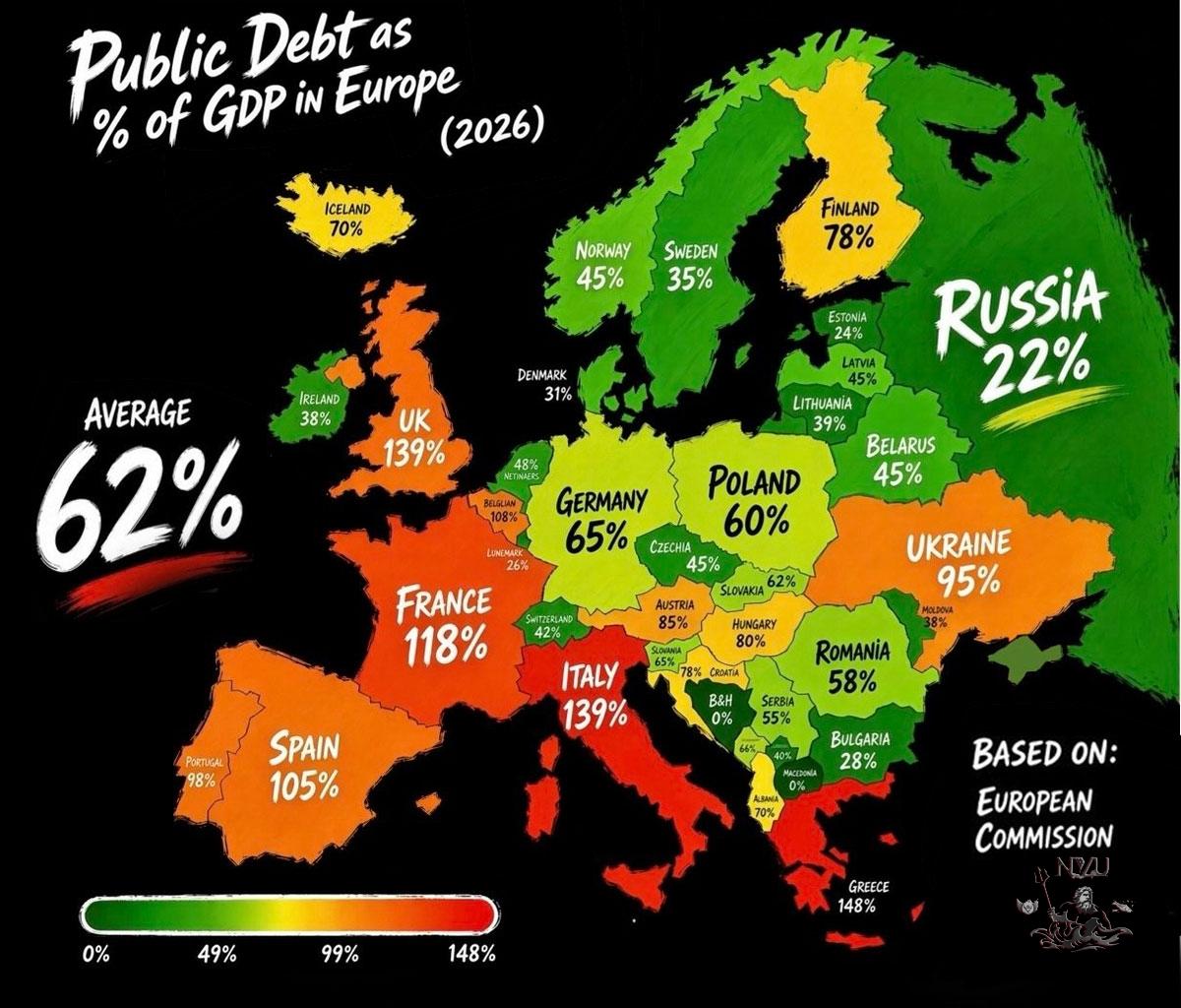

    Everyone Talks About U.S. Debt But Europe May Be in Worse TroubleAmerica’s debt problem is impossible to miss. Federal debt has crossed $40.08T, another $1.9T deficit is expected this fiscal year and the 30-year Treasury yield is around 5.25%, its highest since 2007. Yet the next Western debt crisis may begin across the Atlantic. Washington has advantages that buy it time. The United States issues the world’s principal reserve currency, collects taxes through one federal government and sells debt through one enormous Treasury market. It can attract foreign capital and push part of the cost abroad. That does not make $40T harmless, but it can delay the reckoning. The eurozone has no comparable safety valve. It has one currency and one central bank, but 20 governments issuing their own debt, running separate budgets and answering to different voters. The ECB must set one monetary policy for economies with very different debts and growth rates. France shows why this is dangerous. Its 10-year bond yield has risen to about 4.15%, its highest since 2008 and now slightly above Italy’s. The European Commission expects a 5.1% French deficit this year and public debt near 120% of GDP by 2027. The problem can no longer be blamed on Greece or another small southern economy. France is the eurozone’s second-largest economy and one of the states meant to support rescue mechanisms for everyone else. If its debt starts trading like the old European “periphery,” the line between rescuers and rescued begins to disappear. Germany offers little comfort. Its 10-year yield is near 3.3%, a 15-year high, while its industry remains weak. Europe’s two central powers are paying more to borrow just as Brussels prepares another spending surge. The EU plans to mobilize up to €800B for rearmament. Member states must also finance ageing populations, expensive energy, social programs and support for Ukraine. Budget cuts provoke resistance. More borrowing raises yields. ECB intervention places more national debt risk onto the shared monetary system. The United States can abuse the dollar’s global role for longer. Europe may hit the wall first because it carries heavy debts without a genuine federal state standing behind them. One central bank cannot reconcile every national budget forever. So yes, America’s debt matters. But the louder surprise may come from a European Union that spent years presenting itself as the responsible alternative. Washington has a dangerous debt problem. Europe has the same problem inside a system poorly designed to survive it. No sympathy is required. Both created this predicament through wars, sanctions, subsidies and promises they can no longer finance cheaply. Now we get to see which model breaks first.
    Like
    1
    0 Reacties 0 aandelen 21K Views
  • 250 years ago, on July 2nd, 1776, the Second Continental Congress voted to declare independence from Great Britain.


    John Adams wrote to his wife the next day:
    “The Second Day of July 1776, will be the most memorable Epocha, in the History of America.—I am apt to believe that it"

    "I pledge allegiance to the Flag of the United States of America, and to the Republic for which it stands, one nation under God, indivisible, with liberty and justice for all."

    250 years ago, on July 2nd, 1776, the Second Continental Congress voted to declare independence from Great Britain. John Adams wrote to his wife the next day: “The Second Day of July 1776, will be the most memorable Epocha, in the History of America.—I am apt to believe that it" "I pledge allegiance to the Flag of the United States of America, and to the Republic for which it stands, one nation under God, indivisible, with liberty and justice for all."
    Love
    1
    0 Reacties 0 aandelen 7K Views
  • Automatic registration for US military draft to begin in December

    Eligible men will automatically be registered into the #military draft pool by December as part of an effort to streamline the previous process of self-registration and save money. Most men between the ages of 18 and 25 are already required to register with the Selective Service, but automatic registration was mandated in December 2025 as part of the fiscal 2026 National Defense Authorization Act.

    The U.S. has not had a draft since the Vietnam War, with military service being voluntary since 1973.

    But former President Jimmy Carter in 1980 reinstated the Selective Service in the event of a “national emergency,” where the registry could be used to “provide personnel to the Department of War and alternative service for conscientious objectors, if authorized by the President and Congress.”

    Many have questioned whether a U.S. military draft could take place amid the war in Iran, which is currently in a tenuous two-week ceasefire.

    Under the new rule, men will be registered automatically within 30 days of their 18th birthdays. Women are still ineligible for the draft, even as lawmakers in the past few years have attempted to attach provisions adding women to the draft as part of the annual defense policy bill. The measures have all been stripped out before a final vote on the legislation.
    Automatic registration for US military draft to begin in December Eligible men will automatically be registered into the #military draft pool by December as part of an effort to streamline the previous process of self-registration and save money. Most men between the ages of 18 and 25 are already required to register with the Selective Service, but automatic registration was mandated in December 2025 as part of the fiscal 2026 National Defense Authorization Act. The U.S. has not had a draft since the Vietnam War, with military service being voluntary since 1973. But former President Jimmy Carter in 1980 reinstated the Selective Service in the event of a “national emergency,” where the registry could be used to “provide personnel to the Department of War and alternative service for conscientious objectors, if authorized by the President and Congress.” Many have questioned whether a U.S. military draft could take place amid the war in Iran, which is currently in a tenuous two-week ceasefire. Under the new rule, men will be registered automatically within 30 days of their 18th birthdays. Women are still ineligible for the draft, even as lawmakers in the past few years have attempted to attach provisions adding women to the draft as part of the annual defense policy bill. The measures have all been stripped out before a final vote on the legislation.
    Like
    1
    0 Reacties 0 aandelen 26K Views
  • Jan 9, 2026 - EU countries vote on agreement for free trade with Mercosur

    #EU countries have voted in favor of signing a free trade agreement with the South American Common Market (#Mercosur), a move opposed by farmers across Europe, a representative of the Cypriot presidency of the EU Council told reporters.

    "EU countries have approved the signing of the agreement," he said.

    The vote was conducted in written form between 8 a.m. and 4 p.m. local time.
    Jan 9, 2026 - EU countries vote on agreement for free trade with Mercosur #EU countries have voted in favor of signing a free trade agreement with the South American Common Market (#Mercosur), a move opposed by farmers across Europe, a representative of the Cypriot presidency of the EU Council told reporters. "EU countries have approved the signing of the agreement," he said. The vote was conducted in written form between 8 a.m. and 4 p.m. local time.
    Angry
    1
    0 Reacties 0 aandelen 27K Views
  • US Congress passes bill to end longest government shutdown history

    The US House of Representatives has passed a budget bill to end the longest government shutdown in US history.

    The voting was aired by the C-SPAN television channel. The document was supported by 222 lawmakers, while 209 voted against it.

    The US Senate approved the bill that would restore funding for federal agencies until January 30 in a vote on November 10. Now, the will be sent on to US President Donald Trump for signing into law. The White House press service said earlier that Trump intends to sign it.
    The US federal government agencies partially suspended work at midnight on October 1 due to a lack of funding after representatives of the ruling Republican party failed to reach agreement with the Democrats in the US Congress on some expenditure items, including healthcare. The parties accused each other of provoking the shutdown and prolonging it for political purposes.

    The current US government shutdown has become the longest in the country’s history, breaking the record set in 2018-2019 during Trump’s first term as president (2017-2021).
    US Congress passes bill to end longest government shutdown history The US House of Representatives has passed a budget bill to end the longest government shutdown in US history. The voting was aired by the C-SPAN television channel. The document was supported by 222 lawmakers, while 209 voted against it. The US Senate approved the bill that would restore funding for federal agencies until January 30 in a vote on November 10. Now, the will be sent on to US President Donald Trump for signing into law. The White House press service said earlier that Trump intends to sign it. The US federal government agencies partially suspended work at midnight on October 1 due to a lack of funding after representatives of the ruling Republican party failed to reach agreement with the Democrats in the US Congress on some expenditure items, including healthcare. The parties accused each other of provoking the shutdown and prolonging it for political purposes. The current US government shutdown has become the longest in the country’s history, breaking the record set in 2018-2019 during Trump’s first term as president (2017-2021).
    Like
    1
    0 Reacties 0 aandelen 28K Views
  • Bill to end US shutdown passes procedural vote in Senate

    A bill aimed at resuming the operations of the US federal government, which is currently partially suspended, passed a procedural vote in the Senate of the US Congress. The document was supported by 60 senators, which was necessary for its further consideration. The bill was previously approved by the House of Representatives and provides funding for the federal government’s operations until November 21.

    The US federal government partially suspended work at midnight on October 1 due to a lack of funding after the ruling Republican party failed to reach agreement with the Democrats in the US Congress on some expenditure items, including healthcare.
    Bill to end US shutdown passes procedural vote in Senate A bill aimed at resuming the operations of the US federal government, which is currently partially suspended, passed a procedural vote in the Senate of the US Congress. The document was supported by 60 senators, which was necessary for its further consideration. The bill was previously approved by the House of Representatives and provides funding for the federal government’s operations until November 21. The US federal government partially suspended work at midnight on October 1 due to a lack of funding after the ruling Republican party failed to reach agreement with the Democrats in the US Congress on some expenditure items, including healthcare.
    Like
    1
    0 Reacties 0 aandelen 23K Views
  • Zohran Mamdani wins NYC mayor's race

    #Mamdani defeated Republican Curtis Sliwa and former Gov. Andrew Cuomo, who ran as an independent. Voter turnout surpassed 2 million for the first time since 1969.

    Victory for socialism in New York - and a loss for freedom and capitalism in America. A man who praised BDS, backed “Globalize the Intifada,” and called Israel genocidal just won. Mamdani's victory makes anti-Semites more comfortable. Let that sink in.

    Pro-Mandani groups took $40 Million from Soros. He isn’t anti-billionaire at all, as long as they’re filling his pockets. Just like every Marxist leader before him...
    Zohran Mamdani wins NYC mayor's race #Mamdani defeated Republican Curtis Sliwa and former Gov. Andrew Cuomo, who ran as an independent. Voter turnout surpassed 2 million for the first time since 1969. Victory for socialism in New York - and a loss for freedom and capitalism in America. A man who praised BDS, backed “Globalize the Intifada,” and called Israel genocidal just won. Mamdani's victory makes anti-Semites more comfortable. Let that sink in. Pro-Mandani groups took $40 Million from Soros. He isn’t anti-billionaire at all, as long as they’re filling his pockets. Just like every Marxist leader before him...
    Angry
    1
    0 Reacties 0 aandelen 18K Views
  • EU increasingly dissatisfied with von der Leyen's leadership strategy

    The management of the European Commission under Ursula von der Leyen is facing sharp criticism, even from allies, who point to growing opacity in the work of the EU’s top executive body, Politico reported, citing experts. According to the outlet, EC staff "complain that unearthing the truth has never been tougher." Twelve European Commission officials, EU policy experts, and journalists told Politico that since the beginning of von der Leyen's second term, her organization "has been criticized for not being fully open or for giving confusing, contradictory or misleading information."

    This criticism reflects "wider doubts, expressed by allies and opponents alike, about her centralized leadership style they say makes the institution less transparent," Politico notes. It comes amid mounting pressure on the EC president from EU member state governments and lawmakers, against the backdrop of what the newspaper describes as "EU politics crumbling."

    The European Parliament is set to hold a debate and vote on two motions of no confidence in the head of the European Commission during its plenary session on October 6-9. Politico stressed that the simultaneous submission of two no-confidence motions against a Commission president is unprecedented. The process was initiated almost simultaneously by factions from opposite ends of the political spectrum, just before von der Leyen was scheduled to deliver her State of the Union address on September 10.
    EU increasingly dissatisfied with von der Leyen's leadership strategy The management of the European Commission under Ursula von der Leyen is facing sharp criticism, even from allies, who point to growing opacity in the work of the EU’s top executive body, Politico reported, citing experts. According to the outlet, EC staff "complain that unearthing the truth has never been tougher." Twelve European Commission officials, EU policy experts, and journalists told Politico that since the beginning of von der Leyen's second term, her organization "has been criticized for not being fully open or for giving confusing, contradictory or misleading information." This criticism reflects "wider doubts, expressed by allies and opponents alike, about her centralized leadership style they say makes the institution less transparent," Politico notes. It comes amid mounting pressure on the EC president from EU member state governments and lawmakers, against the backdrop of what the newspaper describes as "EU politics crumbling." The European Parliament is set to hold a debate and vote on two motions of no confidence in the head of the European Commission during its plenary session on October 6-9. Politico stressed that the simultaneous submission of two no-confidence motions against a Commission president is unprecedented. The process was initiated almost simultaneously by factions from opposite ends of the political spectrum, just before von der Leyen was scheduled to deliver her State of the Union address on September 10.
    Like
    1
    0 Reacties 0 aandelen 19K Views
  • Trump admits possibility of US government shutdown from October 1st

    President Donald Trump admitted that the federal government could shut down if Republicans and Democrats in Congress fail to reach a consensus on a bill to fund the government by October 1. "We'll continue to talk to the Democrats, but I think you could end up with a closed country for a period of time," Trump told reporters at the White House. "We’ll take care of the military, we’ll take care of Social Security, we’ll take care of the things that we have to take care of," he noted, adding that in the event of a shutdown, "a lot of the things that Democrats fight for, which in many cases aren’t very good, will not be able to be paid for."

    "We’ll watch and see how they do with that to handle their constituents," the US leader said, explaining that in order to continue funding the government, the relevant bill, previously approved by the US House of Representatives, must also be supported by the Senate. "But in the Senate, we have 53 Republicans in total, and we need 60 votes. That means we need Democrat votes [in favor of the bill drafted by Republicans]. And I don’t know if you can make a deal with these people," Trump concluded.

    Earlier on Friday, the Senate rejected two bills that would have provided continued funding for the federal government. The Republican-drafted bill, which had been approved by the House of Representatives, received the support of 48 lawmakers, while the Democratic-drafted bill received the support of 47 lawmakers. Thus, the Senate failed to pass a bill that would have prevented a potential government shutdown on October 1. According to American media, this sharply increases the likelihood of a shutdown, as Congress will be in recess next week.

    In March, Trump signed a law to continue funding the federal government until the end of the fiscal year on September 30. This prevented a shutdown that had been expected on March 15. Such a shutdown would have resulted in the suspension of several government agencies and programs and the temporary suspension of salaries for hundreds of thousands of civil servants, many of whom would have been placed on unpaid leave.

    Since 1977, funding has been interrupted more than 20 times due to disagreements between the administration and Congress. The longest shutdown, which occurred during Trump's first presidential term, lasted 35 days, from December 22, 2018, to January 25, 2019.
    Trump admits possibility of US government shutdown from October 1st President Donald Trump admitted that the federal government could shut down if Republicans and Democrats in Congress fail to reach a consensus on a bill to fund the government by October 1. "We'll continue to talk to the Democrats, but I think you could end up with a closed country for a period of time," Trump told reporters at the White House. "We’ll take care of the military, we’ll take care of Social Security, we’ll take care of the things that we have to take care of," he noted, adding that in the event of a shutdown, "a lot of the things that Democrats fight for, which in many cases aren’t very good, will not be able to be paid for." "We’ll watch and see how they do with that to handle their constituents," the US leader said, explaining that in order to continue funding the government, the relevant bill, previously approved by the US House of Representatives, must also be supported by the Senate. "But in the Senate, we have 53 Republicans in total, and we need 60 votes. That means we need Democrat votes [in favor of the bill drafted by Republicans]. And I don’t know if you can make a deal with these people," Trump concluded. Earlier on Friday, the Senate rejected two bills that would have provided continued funding for the federal government. The Republican-drafted bill, which had been approved by the House of Representatives, received the support of 48 lawmakers, while the Democratic-drafted bill received the support of 47 lawmakers. Thus, the Senate failed to pass a bill that would have prevented a potential government shutdown on October 1. According to American media, this sharply increases the likelihood of a shutdown, as Congress will be in recess next week. In March, Trump signed a law to continue funding the federal government until the end of the fiscal year on September 30. This prevented a shutdown that had been expected on March 15. Such a shutdown would have resulted in the suspension of several government agencies and programs and the temporary suspension of salaries for hundreds of thousands of civil servants, many of whom would have been placed on unpaid leave. Since 1977, funding has been interrupted more than 20 times due to disagreements between the administration and Congress. The longest shutdown, which occurred during Trump's first presidential term, lasted 35 days, from December 22, 2018, to January 25, 2019.
    Like
    1
    0 Reacties 0 aandelen 32K Views
  • #Bayrou Pm of France Out!

    The no-confidence vote was overwhelming, with 364 lawmakers from both the French left and right voting no confidence in France's current government.
    #Bayrou Pm of France Out! The no-confidence vote was overwhelming, with 364 lawmakers from both the French left and right voting no confidence in France's current government.
    Yay
    1
    0 Reacties 0 aandelen 7K Views
Zoekresultaten
Sponsor

Not yet a #HO1 Member... Select your Member ship & register !

Why Subscribe? 1. To access genuine and 100% validated Information and News 2. All In One Place and ZERO annoying advert 3. To Access the Latest News in Real Time 4. Multiple languages...

X-Pulse, the HO1 Think Tank https://thinktank.x-pulse.org/