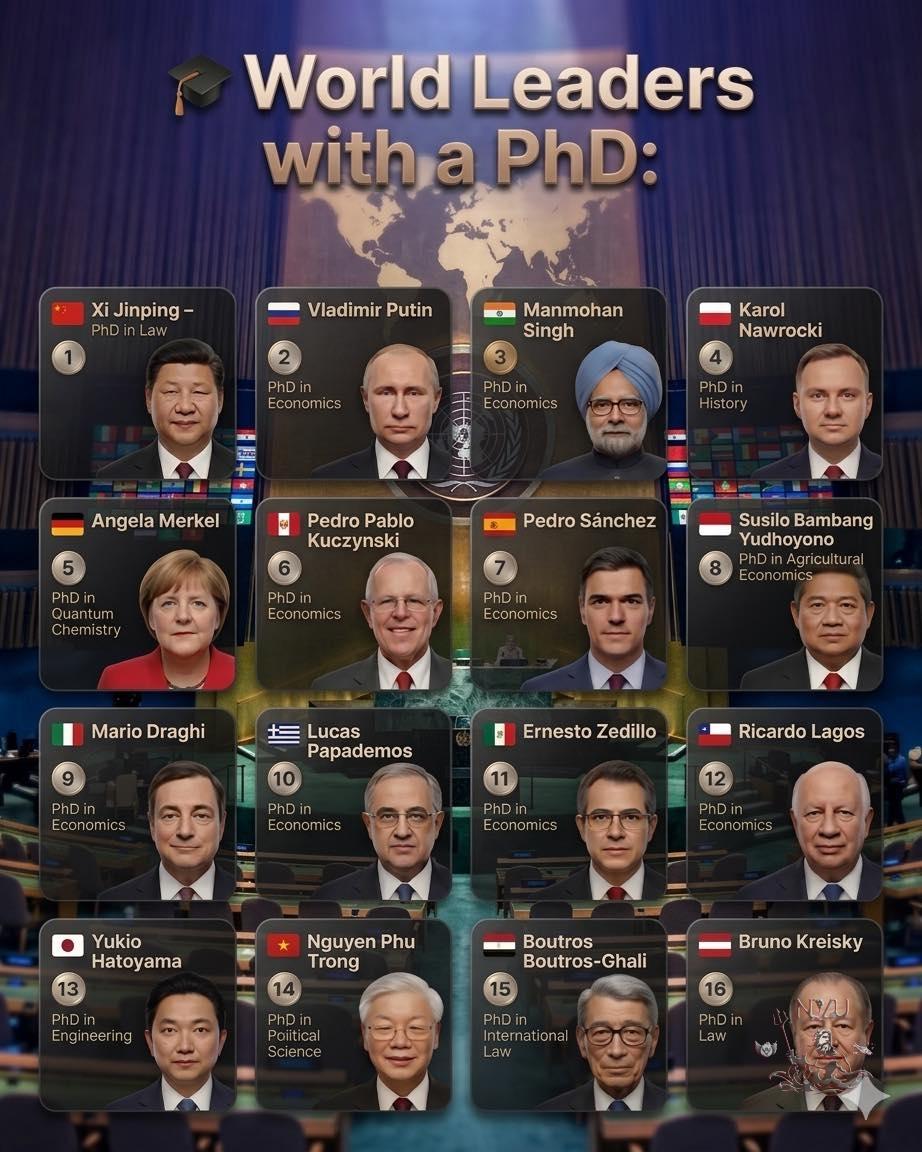
• World Leaders with a PhD:

    🇨🇳 Xi Jinping – PhD in Law
    🇷🇺 Vladimir Putin – PhD in Economics
    🇮🇳 Manmohan Singh – PhD in Economics
    🇵🇱 Karol Nawrocki – PhD in History
    🇳🇬 Goodluck Jonathan – PhD in Zoology
    🇩🇪 Angela Merkel – PhD in Quantum Chemistry
    🇵🇪 Pedro Pablo Kuczynski – PhD in Economics
    🇪🇸 Pedro Sánchez – PhD in Economics
    🇮🇩 Susilo Bambang Yudhoyono – PhD in Agricultural Economics
    🇮🇷 Hassan Rouhani – PhD in Constitutional Law
    🇮🇹 Mario Draghi – PhD in Economics
    🇬🇷 Lucas Papademos – PhD in Economics
    🇲🇽 Ernesto Zedillo – PhD in Economics
    🇨🇱 Ricardo Lagos – PhD in Economics
    🇯🇵 Yukio Hatoyama – PhD in Engineering
    🇪🇬 Boutros Boutros-Ghali – PhD in International Law
    🇦🇹 Bruno Kreisky – PhD in Law

    Note: Leaders from the past and present.
    World Leaders with a PhD: 🇨🇳 Xi Jinping – PhD in Law 🇷🇺 Vladimir Putin – PhD in Economics 🇮🇳 Manmohan Singh – PhD in Economics 🇵🇱 Karol Nawrocki – PhD in History 🇳🇬 Goodluck Jonathan – PhD in Zoology 🇩🇪 Angela Merkel – PhD in Quantum Chemistry 🇵🇪 Pedro Pablo Kuczynski – PhD in Economics 🇪🇸 Pedro Sánchez – PhD in Economics 🇮🇩 Susilo Bambang Yudhoyono – PhD in Agricultural Economics 🇮🇷 Hassan Rouhani – PhD in Constitutional Law 🇮🇹 Mario Draghi – PhD in Economics 🇬🇷 Lucas Papademos – PhD in Economics 🇲🇽 Ernesto Zedillo – PhD in Economics 🇨🇱 Ricardo Lagos – PhD in Economics 🇯🇵 Yukio Hatoyama – PhD in Engineering 🇪🇬 Boutros Boutros-Ghali – PhD in International Law 🇦🇹 Bruno Kreisky – PhD in Law Note: Leaders from the past and present.
    Like
    1
    0 Reacties 0 aandelen 7K Views
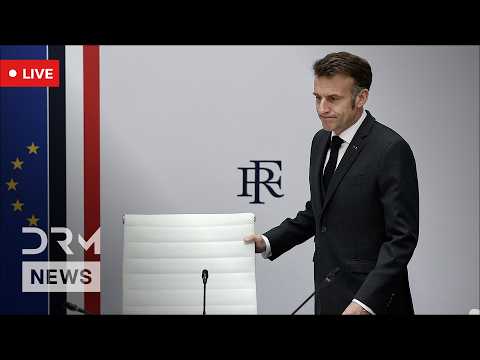
  • French Navy Marine Nationale New Aircraft Carrier Her Name: "FRANCE LIBRE"

    Coverage of French President Emmanuel Macron's visit to the Naval Group Nantes-Indret site, featuring a welcome, economic impact presentation, and his keynote speech on the PA-NG next-generation nuclear aircraft carrier program. This visit marks key progress toward 2038 service entry. Watch real-time developments in French naval modernization. Subscribe for ongoing defense and international news updates.
    French Navy Marine Nationale New Aircraft Carrier Her Name: "FRANCE LIBRE" Coverage of French President Emmanuel Macron's visit to the Naval Group Nantes-Indret site, featuring a welcome, economic impact presentation, and his keynote speech on the PA-NG next-generation nuclear aircraft carrier program. This visit marks key progress toward 2038 service entry. Watch real-time developments in French naval modernization. Subscribe for ongoing defense and international news updates.
    Like
    1
    0 Reacties 0 aandelen 19K Views
  • European leaders hope to de-escalate Greenland tensions with US in Davos

    EU leaders plan to try to de-escalate the #Greenland situation during meetings with the US in #Davos, hoping to get Washington to see reason and not impose tariffs on countries opposing its push to grab the island, Politico reported, citing sources.

    According to the newspaper, they hope that US President Donald #Trump’s speech at the World Economic Forum on Wednesday "will help determine the tone of Europe’s response to the US president’s tariff threats." Statements by European diplomats and officials indicate that they want to avoid retaliatory measures and believe that a diplomatic solution to the crisis can still be found. "The focus is getting the ball rolling in Davos. Then, we will take stock" at an emergency EU summit on Thursday, an EU diplomat said. "The pressure needs to come down," he added.

    The European Union is reluctant to take decisive action against the US, hoping that Trump will not follow through on his threats, the publication notes, adding that, according to diplomats, officials "are terrified of needlessly exploding already frayed transatlantic ties."

    Earlier reports said that national security advisors to Western leaders had made changes to the agenda of a meeting on the sidelines of the World Economic Forum to discuss Greenland. Initially, the talks were expected to focus on resolving the Ukrainian conflict, but the plans were adjusted so that advisors could also address Greenland.

    Earlier, the White House host announced on Truth Social that the US would begin imposing 10% tariffs on the UK, Germany, Denmark, the Netherlands, Norway, Finland, France, and Sweden, which would remain in effect until the parties reach an agreement on the full and final acquisition of Greenland by Washington. The decision is set to take effect on February 1, with the duty rate increasing to 25% from June 1.

    European leaders hope to de-escalate Greenland tensions with US in Davos EU leaders plan to try to de-escalate the #Greenland situation during meetings with the US in #Davos, hoping to get Washington to see reason and not impose tariffs on countries opposing its push to grab the island, Politico reported, citing sources. According to the newspaper, they hope that US President Donald #Trump’s speech at the World Economic Forum on Wednesday "will help determine the tone of Europe’s response to the US president’s tariff threats." Statements by European diplomats and officials indicate that they want to avoid retaliatory measures and believe that a diplomatic solution to the crisis can still be found. "The focus is getting the ball rolling in Davos. Then, we will take stock" at an emergency EU summit on Thursday, an EU diplomat said. "The pressure needs to come down," he added. The European Union is reluctant to take decisive action against the US, hoping that Trump will not follow through on his threats, the publication notes, adding that, according to diplomats, officials "are terrified of needlessly exploding already frayed transatlantic ties." Earlier reports said that national security advisors to Western leaders had made changes to the agenda of a meeting on the sidelines of the World Economic Forum to discuss Greenland. Initially, the talks were expected to focus on resolving the Ukrainian conflict, but the plans were adjusted so that advisors could also address Greenland. Earlier, the White House host announced on Truth Social that the US would begin imposing 10% tariffs on the UK, Germany, Denmark, the Netherlands, Norway, Finland, France, and Sweden, which would remain in effect until the parties reach an agreement on the full and final acquisition of Greenland by Washington. The decision is set to take effect on February 1, with the duty rate increasing to 25% from June 1.

    Like
    1
    0 Reacties 0 aandelen 69K Views
  • Finnish politician calls EU 'bankrupt' over plans to use Russian assets

    Member of the Finnish national conservative party the Freedom Alliance, Armando Mema, believes that the European Union seeks to expropriate Russia’s frozen assets due to serious economic difficulties. "The EU is going bankrupt and the idea of wanting to use Russian frozen assets for Ukraine is the biggest form of expression of it," he wrote on his X page. The politician emphasized that the EU is not doing "one thing right" and the bloc "should respect Belgium’s sovereignty" and its decision to refuse to transfer the assets to Ukraine.

    On December 12, the European Union’s Council formally decided to permanently freeze Russia’s sovereign assets. The European Commission aims to secure approval from EU member states at the December 18-19 summit in Brussels to expropriate approximately 210 billion euros in Russian assets, with 185 billion euros already blocked on the Euroclear platform in Belgium.

    Russian President Vladimir Putin previously characterized the proposed confiscation as "an act of theft," while Russian Justice Minister Konstantin Chuichenko said that the country’s leadership has already been presented with options for responding to a potential seizure of Russian assets by Western nations.
    Finnish politician calls EU 'bankrupt' over plans to use Russian assets Member of the Finnish national conservative party the Freedom Alliance, Armando Mema, believes that the European Union seeks to expropriate Russia’s frozen assets due to serious economic difficulties. "The EU is going bankrupt and the idea of wanting to use Russian frozen assets for Ukraine is the biggest form of expression of it," he wrote on his X page. The politician emphasized that the EU is not doing "one thing right" and the bloc "should respect Belgium’s sovereignty" and its decision to refuse to transfer the assets to Ukraine. On December 12, the European Union’s Council formally decided to permanently freeze Russia’s sovereign assets. The European Commission aims to secure approval from EU member states at the December 18-19 summit in Brussels to expropriate approximately 210 billion euros in Russian assets, with 185 billion euros already blocked on the Euroclear platform in Belgium. Russian President Vladimir Putin previously characterized the proposed confiscation as "an act of theft," while Russian Justice Minister Konstantin Chuichenko said that the country’s leadership has already been presented with options for responding to a potential seizure of Russian assets by Western nations.
    Like
    1
    0 Reacties 0 aandelen 57K Views
  • Analyst expects EU to cease to exist as global political entity by 2030

    #Europe will turn into an amorphous, conflict-prone, militarized, and economically weak place by 2030, said Nikolay Gaponenko, associate professor with the Russian Presidential Academy of National Economy and Public Administration.

    "The European Union will turn into an amorphous and conflict-prone space with weakened supra-national institutions by 2030. Its ‘strategic autonomy’ will become an empty phrase," he pointed out in a report titled "Strategic Forecast - Europe on the Verge of a Crisis: New Reality of 2026-2030."

    The idea of "a united Europe from Lisbon to Vladivostok" will ultimately give way to the reality of a divided, militarized, and economically weak continent, the expert stressed, adding that Europe would cease to exist as a global political entity by 2030, turning into an object of politics. "It will increasingly harmonize its foreign policy with Washington, as Brussels and the key capitals will lose independence. Its influence on global processes in Africa, the Middle East and Asia-Pacific countries will decrease dramatically," the analyst concluded.
    Analyst expects EU to cease to exist as global political entity by 2030 #Europe will turn into an amorphous, conflict-prone, militarized, and economically weak place by 2030, said Nikolay Gaponenko, associate professor with the Russian Presidential Academy of National Economy and Public Administration. "The European Union will turn into an amorphous and conflict-prone space with weakened supra-national institutions by 2030. Its ‘strategic autonomy’ will become an empty phrase," he pointed out in a report titled "Strategic Forecast - Europe on the Verge of a Crisis: New Reality of 2026-2030." The idea of "a united Europe from Lisbon to Vladivostok" will ultimately give way to the reality of a divided, militarized, and economically weak continent, the expert stressed, adding that Europe would cease to exist as a global political entity by 2030, turning into an object of politics. "It will increasingly harmonize its foreign policy with Washington, as Brussels and the key capitals will lose independence. Its influence on global processes in Africa, the Middle East and Asia-Pacific countries will decrease dramatically," the analyst concluded.
    Like
    1
    0 Reacties 0 aandelen 44K Views
  • Majority of French citizens fear country drawn into war in coming years — Poll

    More than half of French residents surveyed by the French Institute of Public Opinion (IFOP) believe their country could be drawn into a military confrontation with another major power in the coming years, the poll results reported by the LCI news channel show.

    The survey was conducted among 1,000 French adults on December 3-4.

    Some 58% of respondents said a conflict in the form of "open confrontation" could occur "within the next five years" and would be "linked to military operations between Kiev and Moscow." Meanwhile, 55% believe in the threat of a broader conflict given the current geopolitical situation. Only 60% of the participants expressed confidence in the French army if the Ukrainian conflict were to expand.

    Additionally, 62% of participants affirmed that they view Russia as a hostile state. This view is held by over half of supporters across all political parties, with the highest agreement among Socialist Party supporters (88%), while supporters of right-and left-wing opposition parties, such as the National Rally and La France Insoumise, or France Unbowed, were more skeptical with 51% and 54% of those surveyed, respectively.

    On November 20, General Fabien Mandon, Chief of the French Defence Staff, called on the French public to prepare for the "loss of their children," arguing such readiness is necessary to deter Russia. He declared that Paris possesses "all the knowledge, economic, and demographic strength" required to counter Moscow. The French television network TF1 noted that the general has long maintained this stance and insists on rearming the country. Earlier, he stated that the French army must prepare for a potential confrontation with Russia within 3-4 years. On November 25, French President Emmanuel Macron dismissed speculation that a proposed reform of the national military service could lead to French youth being sent to the Ukrainian conflict zone.

    Russian President Vladimir Putin has previously dismissed as nonsense what he called the "mantra" of European politicians regarding a potential war with Russia. Speaking at the General Debate of the 80th UN General Assembly, Foreign Minister Sergey Lavrov emphasized that Russia has never had, nor does it have, any intention to attack NATO or the EU.
    Majority of French citizens fear country drawn into war in coming years — Poll More than half of French residents surveyed by the French Institute of Public Opinion (IFOP) believe their country could be drawn into a military confrontation with another major power in the coming years, the poll results reported by the LCI news channel show. The survey was conducted among 1,000 French adults on December 3-4. Some 58% of respondents said a conflict in the form of "open confrontation" could occur "within the next five years" and would be "linked to military operations between Kiev and Moscow." Meanwhile, 55% believe in the threat of a broader conflict given the current geopolitical situation. Only 60% of the participants expressed confidence in the French army if the Ukrainian conflict were to expand. Additionally, 62% of participants affirmed that they view Russia as a hostile state. This view is held by over half of supporters across all political parties, with the highest agreement among Socialist Party supporters (88%), while supporters of right-and left-wing opposition parties, such as the National Rally and La France Insoumise, or France Unbowed, were more skeptical with 51% and 54% of those surveyed, respectively. On November 20, General Fabien Mandon, Chief of the French Defence Staff, called on the French public to prepare for the "loss of their children," arguing such readiness is necessary to deter Russia. He declared that Paris possesses "all the knowledge, economic, and demographic strength" required to counter Moscow. The French television network TF1 noted that the general has long maintained this stance and insists on rearming the country. Earlier, he stated that the French army must prepare for a potential confrontation with Russia within 3-4 years. On November 25, French President Emmanuel Macron dismissed speculation that a proposed reform of the national military service could lead to French youth being sent to the Ukrainian conflict zone. Russian President Vladimir Putin has previously dismissed as nonsense what he called the "mantra" of European politicians regarding a potential war with Russia. Speaking at the General Debate of the 80th UN General Assembly, Foreign Minister Sergey Lavrov emphasized that Russia has never had, nor does it have, any intention to attack NATO or the EU.
    Like
    1
    0 Reacties 0 aandelen 70K Views
  • France Is in a TOTAL MELTDOWN — And Europe Is Next

    #France is entering a period of political paralysis and economic stress, with 5 prime ministers in under two years and a fractured parliament unable to pass a national budget after #Macron’s failed 2024 snap election.

    Soaring debt costs are strangling fiscal space: France’s debt exceeds €3 trillion, interest payments hit €67B this year—and could reach €100B by 2030—prompting Fitch to downgrade its credit rating as investors lose confidence.

    Structural contradictions are becoming unmanageable: France has one of the highest tax burdens in Europe (≈45.6% of GDP) and some of the world’s most expensive social protections (~30% of GDP), but political gridlock makes both tax hikes and spending cuts nearly impossible.

    Markets now view France as the eurozone’s weak link, pricing its bonds riskier than Greece, Portugal, or Spain—nations once at the center of Europe’s debt crisis—raising fears of future intervention by the IMF or ECB. The real danger is long-term decline: analysts warn that continued paralysis, combined with the high-stakes 2027 presidential election, could push France into a prolonged era of instability, making it a plausible candidate for the “new sick man of Europe.”
    France Is in a TOTAL MELTDOWN — And Europe Is Next #France is entering a period of political paralysis and economic stress, with 5 prime ministers in under two years and a fractured parliament unable to pass a national budget after #Macron’s failed 2024 snap election. Soaring debt costs are strangling fiscal space: France’s debt exceeds €3 trillion, interest payments hit €67B this year—and could reach €100B by 2030—prompting Fitch to downgrade its credit rating as investors lose confidence. Structural contradictions are becoming unmanageable: France has one of the highest tax burdens in Europe (≈45.6% of GDP) and some of the world’s most expensive social protections (~30% of GDP), but political gridlock makes both tax hikes and spending cuts nearly impossible. Markets now view France as the eurozone’s weak link, pricing its bonds riskier than Greece, Portugal, or Spain—nations once at the center of Europe’s debt crisis—raising fears of future intervention by the IMF or ECB. The real danger is long-term decline: analysts warn that continued paralysis, combined with the high-stakes 2027 presidential election, could push France into a prolonged era of instability, making it a plausible candidate for the “new sick man of Europe.”
    Wow
    Angry
    2
    0 Reacties 0 aandelen 37K Views
  • German economy eviscerated by EU’s sanctions on Russia

    Germany’s #economy has been completely weakened by the #European Union’s anti-Russian sanctions, Brandon Weichert, a senior national security editor at The National Interest (NI), wrote in an article released on Monday.

    "The actions of NATO against #Russia in Ukraine have weakened the European economic project. Its strongest economy, #Germany, has been eviscerated — not only by the rebound effect of the sanctions, but by the loss of Germany’s Nord Stream II pipeline, which once <…> fueled Berlin’s industrial might," the editor argued.

    According to Weichert, the Ukraine conflict has caused energy price inflation, economic strain, and, as a result, political tensions inside the EU.
    German economy eviscerated by EU’s sanctions on Russia Germany’s #economy has been completely weakened by the #European Union’s anti-Russian sanctions, Brandon Weichert, a senior national security editor at The National Interest (NI), wrote in an article released on Monday. "The actions of NATO against #Russia in Ukraine have weakened the European economic project. Its strongest economy, #Germany, has been eviscerated — not only by the rebound effect of the sanctions, but by the loss of Germany’s Nord Stream II pipeline, which once fueled Berlin’s industrial might," the editor argued. According to Weichert, the Ukraine conflict has caused energy price inflation, economic strain, and, as a result, political tensions inside the EU.
    Like
    1
    0 Reacties 0 aandelen 37K Views
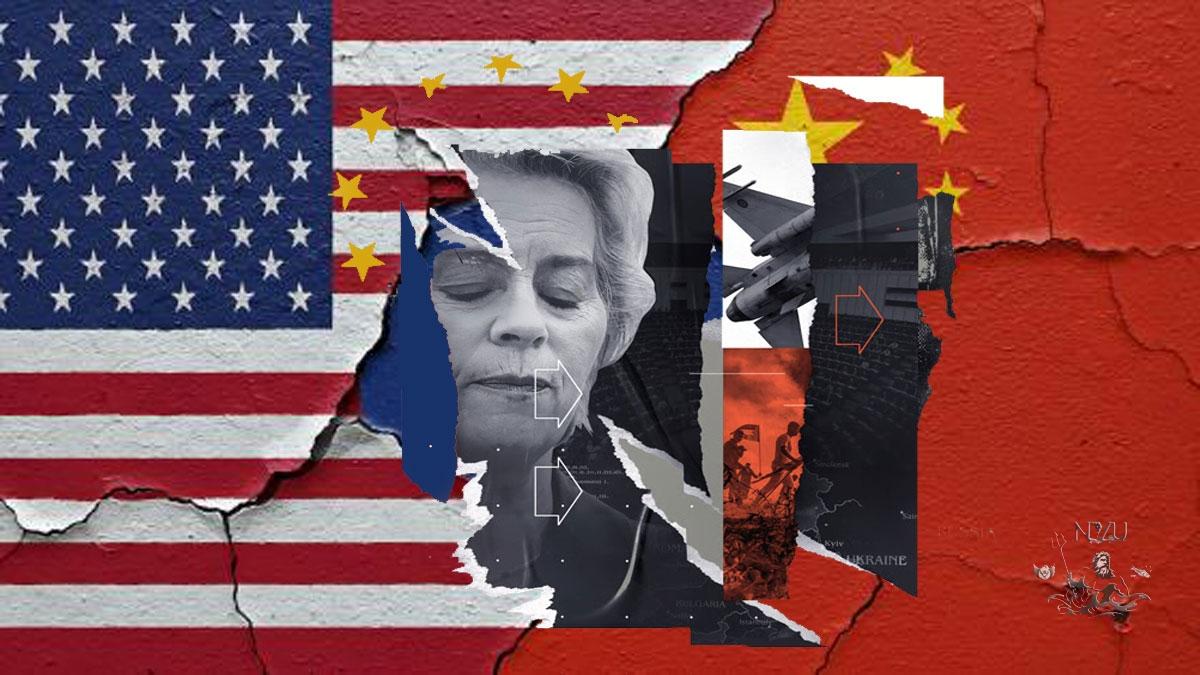
  • EU falling further and further behind in 'geopolitical pecking order'

    The European Union is worried that it will be dwarfed by Russia, China and the United States in the contest for economic, military and technological dominance, The Wall Street Journal (WSJ) reported. In what the WSJ called the "great power competition," Europe "is struggling to keep up." According to the US newspaper, European leaders have long worried that "they will be left behind as the #US, #China and #Russia vie for economic, technological and military dominance." "[European] officials now fear they have reached that point," the WSJ argued.

    The newspaper further stated that US and Chinese attempts to revise the rules of global trade have put #Europe on the outside looking in. Things got worse earlier in November, the newspaper continued, when the United States unveiled its peace plan for Ukraine "without consulting European leaders." Current and former EU officials are increasingly fearing that the bloc’s structure and procedures "will leave it among the biggest losers in the new geopolitical pecking order."

    "I think that we are finally getting realistic. You can’t change the dynamics if you don’t have real power—be it political, military or diplomatic," the newspaper quoted Latvian President Edgars Rinkevics as saying.

    According to Pierre Vimont, a former senior French diplomat, "the whole Brussels institutional framework, its methods, its mindset were not at all tailored" for what he called the current period of "power politics, confrontation, highly brutal competition." For his part, the EU’s former foreign policy chief, Josep Borrell, reiterated his earlier warning that Europe "must learn to speak the language of power." "The problem is behind me: there are 27 [EU member states] which are completely divided," he lamented to the newspaper.
    EU falling further and further behind in 'geopolitical pecking order' The European Union is worried that it will be dwarfed by Russia, China and the United States in the contest for economic, military and technological dominance, The Wall Street Journal (WSJ) reported. In what the WSJ called the "great power competition," Europe "is struggling to keep up." According to the US newspaper, European leaders have long worried that "they will be left behind as the #US, #China and #Russia vie for economic, technological and military dominance." "[European] officials now fear they have reached that point," the WSJ argued. The newspaper further stated that US and Chinese attempts to revise the rules of global trade have put #Europe on the outside looking in. Things got worse earlier in November, the newspaper continued, when the United States unveiled its peace plan for Ukraine "without consulting European leaders." Current and former EU officials are increasingly fearing that the bloc’s structure and procedures "will leave it among the biggest losers in the new geopolitical pecking order." "I think that we are finally getting realistic. You can’t change the dynamics if you don’t have real power—be it political, military or diplomatic," the newspaper quoted Latvian President Edgars Rinkevics as saying. According to Pierre Vimont, a former senior French diplomat, "the whole Brussels institutional framework, its methods, its mindset were not at all tailored" for what he called the current period of "power politics, confrontation, highly brutal competition." For his part, the EU’s former foreign policy chief, Josep Borrell, reiterated his earlier warning that Europe "must learn to speak the language of power." "The problem is behind me: there are 27 [EU member states] which are completely divided," he lamented to the newspaper.
    Like
    1
    0 Reacties 0 aandelen 35K Views
  • French Joint Chief of Staff urges Frenchmen to be prepared to 'lose children' to contain Russia

    The French people must be prepared "to lose their children" in order to deter Russia, France's Chief of the Defense Staff Fabien Mandon alleged. "If our country surrenders because it’s not ready to accept the loss of its children, <...> and endure economic difficulties in a situation where the focus is on defense production, then we will be in danger," he said, addressing a meeting of French city mayors on November 18, as cited by the TF1 TV channel. Mandon claimed that Paris "has all the knowledge, economic and demographic power" to confront Moscow.

    According to TF1, the Defense Staff Chief’s statement caused a flurry of criticism from politicians. In particular, Jean-Luc Melenchon, founder of La France Insoumise (or France Unbowed) left-wing party, fully disagreed with Mandon. "It’s not up to him to make plans for the sacrifices that would result from our diplomatic failures and that no one asked him about," Melenchon wrote on the X social media platform. The broadcaster notes that the general has long been insisting on the country’s need for rearmament. Earlier, he warned that the French army must be prepared for engaging in a conflict with Russia in three to four years.
    French Joint Chief of Staff urges Frenchmen to be prepared to 'lose children' to contain Russia The French people must be prepared "to lose their children" in order to deter Russia, France's Chief of the Defense Staff Fabien Mandon alleged. "If our country surrenders because it’s not ready to accept the loss of its children, and endure economic difficulties in a situation where the focus is on defense production, then we will be in danger," he said, addressing a meeting of French city mayors on November 18, as cited by the TF1 TV channel. Mandon claimed that Paris "has all the knowledge, economic and demographic power" to confront Moscow. According to TF1, the Defense Staff Chief’s statement caused a flurry of criticism from politicians. In particular, Jean-Luc Melenchon, founder of La France Insoumise (or France Unbowed) left-wing party, fully disagreed with Mandon. "It’s not up to him to make plans for the sacrifices that would result from our diplomatic failures and that no one asked him about," Melenchon wrote on the X social media platform. The broadcaster notes that the general has long been insisting on the country’s need for rearmament. Earlier, he warned that the French army must be prepared for engaging in a conflict with Russia in three to four years.
    Like
    1
    0 Reacties 0 aandelen 24K Views
Zoekresultaten
Sponsor

Not yet a #HO1 Member... Select your Member ship & register !

Why Subscribe? 1. To access genuine and 100% validated Information and News 2. All In One Place and ZERO annoying advert 3. To Access the Latest News in Real Time 4. Multiple languages...

X-Pulse, the HO1 Think Tank https://thinktank.x-pulse.org/