


 DONATIONS
 Worldwide Radio Stations
Netanyahu’s future at stake as Israel votes amid high Arab turnout
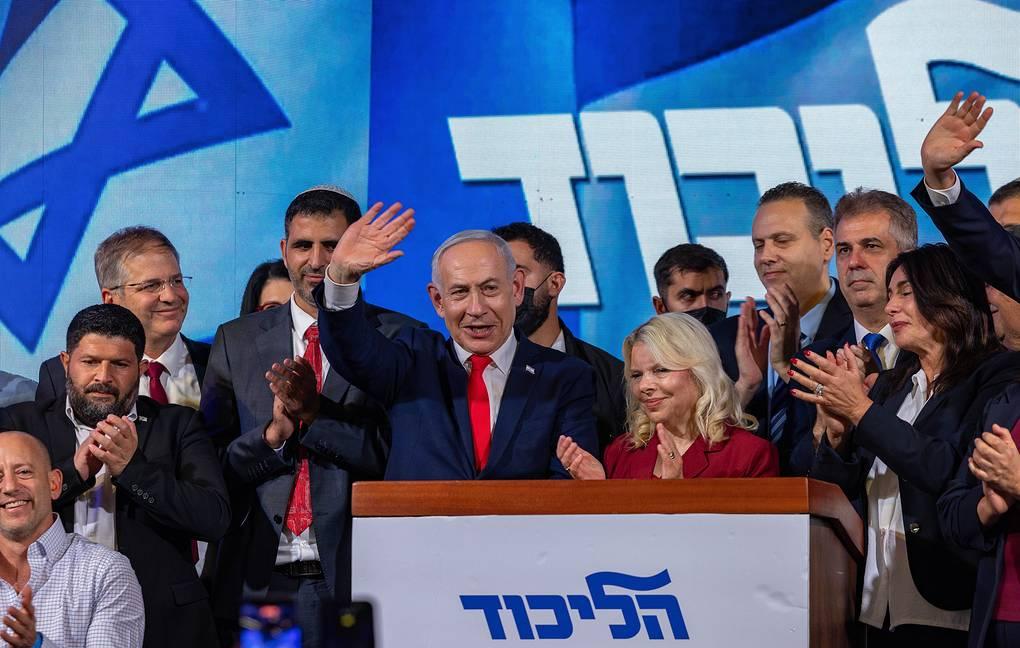
Israel’s Likud party, led by Prime Minister Benjamin Netanyahu, is holding on to its lead in the October 27 parliamentary elections, with 57.3% of the vote counted, according to data released by the Central Elections Committee.
The Yashar party of Netanyahu’s main rival, Gadi Eisenkot, is in second place. The Central Elections Committee is expected to announce preliminary results on October 29, with the final election outcome to be officially published no later than November 4.
Key details available so far....
Exit polls and seat distribution
- Prime Minister Benjamin Netanyahu’s Likud party is holding on to its lead in the elections, with 57.3% of the vote counted, according to data released by the Central Elections Committee.
- According to this data, Netanyahu’s party is projected to win 28 seats in the 120-seat parliament.
- His main rival, Gadi Eisenkot, leader of the Yashar opposition party, is in second place with 21 seats.
- Meanwhile, Netanyahu’s bloc of parties is currently projected to win a total of 55 seats, while the opposition is expected to secure 49.
- Arab parties are projected to win 16 seats, although neither Likud nor the opposition is prepared to form a coalition with them.
- According to exit polls, the Beyachad (Together) bloc, led by former prime ministers Naftali Bennett and Yair Lapid, ranks third with 14 seats.
- The center-left Democrats, led by Yair Golan, and the Arab Joint List, led by Yousef Jabareen, are expected to win ten seats each.
- Avigdor Lieberman’s party, Our Home Israel, which focuses on the interests of Israel's Russian-speaking community, is projected to win eight seats.
- The United Arab List (Ra’am), led by Mansour Abbas, and the far-right party Otzma Yehudit (Jewish Power), led by Itamar Ben-Gvir, are projected to receive seven seats each.
- The ultra-Orthodox parties Shas and United Torah Judaism, along with the far-right bloc comprising the Religious Zionist Party and Zehut, are each expected to win six seats.
- Other political forces are not expected to surpass the 3.25% electoral threshold.
- A total of 36 parties and alliances participated in the elections.
- A governing majority requires 61 seats in the 120-seat Knesset, but, according to exit polls, no political force is expected to reach that number.
Voter turnout
- Parliamentary elections in Israel are held under a party-list system.
- A total of 7.3 mln Israeli citizens are eligible to vote.
- Voter turnout in the elections to the 26th Knesset was 77.7%, the highest level since 1999, Israel’s Channel 12 reported.
- United Arab List leader Mansour Abbas said that turnout in Arab-populated areas had reached 80%.
- He stressed that Arab voters had been more active than other voters.
Election results
- The Central Elections Committee is expected to announce preliminary results on October 29, with the final election outcome to be officially published no later than November 4.
- Once the final results are announced, President Isaac Herzog will begin consultations with representatives of the parties that have won seats in the Knesset before asking one of them to form a new government coalition.
Prime minister’s post
- According to Amjad Shbeita, coordinator of the Joint List coalition of Arab parties, left-wing and democratic forces have a strong chance of unseating Benjamin Netanyahu’s government.
- Netanyahu previously claimed that opposition parties were trying "to steal the elections" from his bloc.
- Posts urging supporters to turn out in greater numbers appeared on Netanyahu’s X account approximately three times an hour, along with allegations that Arab parties were transporting thousands of their supporters to polling stations to secure more votes.
- As a rule, the leader of the party that wins the most seats in parliament becomes a candidate for the post of prime minister.
- However, the president may also task a politician whose party did not win the most seats with forming a cabinet, provided the party has a chance of forming a coalition.
- The first candidate for prime minister will have 28 days to form a government, with the possibility of a two-week extension.
- If the candidate fails, the president will assign the task to another lawmaker, who will have two weeks to form a cabinet, with no option for an extension.
- If no government can be formed with the support of at least 61 members of parliament, a new election will be called within 90 days.
***

CryptoCurrency Rates
© 2026 X-Pulse, the HO1 Think Tank
 Spanish
 English
 Arabic
 French
 Portuguese
 Deutsch
 Turkish
 Dutch
 Italiano
 Russian
 Romaian
 Portuguese (Brazil)
 Greek