


 DONATIONS
 Worldwide Radio Stations
CFR - Top conflicts to watch in 2025

The possibility that the U.S. could find itself in wars with not one but two major, nuclear-armed powers simultaneously is very real. The stakes today... cannot be overstated.
The level of armed conflict around the world has steadily grown in recent years, which in turn has increased the risk of costly U.S. military intervention. This is particularly the case in the Middle East, which continues to be wracked by deadly violence across multiple countries. This violence has clear potential to intensify and spread. The horrific war in Ukraine that by some estimates has already claimed a million casualties also shows no sign of abating. This conflict could likewise escalate in ways that threaten vital U.S. interests and necessitate much deeper and more costly involvement. While the situation in the Indo-Pacific region is comparatively peaceful, numerous flashpoints exist, not least across the Taiwan Strait and in the South China Sea, that could suddenly ignite and rapidly draw in the U.S.
There have never been so many contingencies rated as high likelihood/high impact events (five) since the PPS began in 2008. Put differently, the level of anxiety that survey respondents feel about the risk of violent conflict over the coming twelve months has never been greater. Of the thirty contingencies surveyed, twenty-eight are judged to be either highly or moderately likely to occur in the next twelve months. Eighteen of those, moreover, would have a high or moderate impact on U.S. interests.
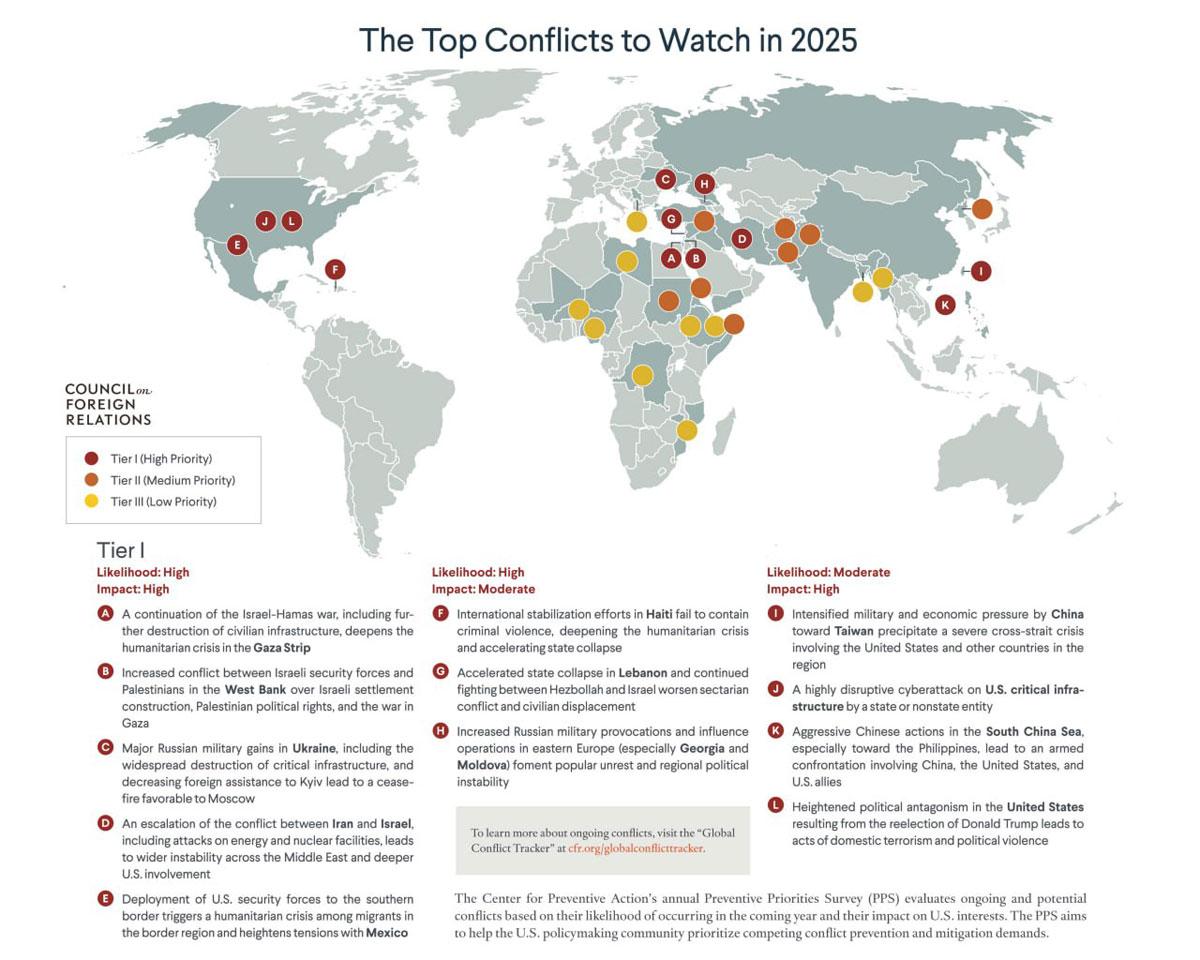
1. A further deterioration of ongoing conflicts in the Middle East in 2025 represents the leading concern of survey respondents. This includes a continuation of the Israel-Hamas war in Gaza, an increase in clashes between Israeli security forces and Palestinians in the West Bank, an escalation of hostilities between Iran and Israel, and, finally, persistent fighting between Israel and Hezbollah militants and state collapse in Lebanon.
2. Second only to the Middle East as a source of Tier I concerns are those conflicts that stem from the aggressive behavior of Russia (toward Ukraine and in other parts of eastern Europe) and China (toward Taiwan and in the South China Sea). However, whereas Russia-related contingencies are considered highly likely to occur in 2025, those that are China-related are judged as moderately likely.
The Trump administration should not only be clear sighted about the risks of an increasingly turbulent world but also craft policies designed to deliberately lessen the dangers ahead. Otherwise, it could become overwhelmed by multiple concurrent crises with calamitous consequences for the United States. But where to focus finite U.S. resources, not to mention the limited attention spans of busy policymakers? Besides the conflict risks listed above, there are other ongoing or potential conflicts, especially in Africa, that may not have the same strategic importance but nonetheless represent major humanitarian imperatives. In addition, emerging risks closer to home in the Western Hemisphere cannot be ignored, nor can domestic threats to political stability.
Ukraine War: Why a Ceasefire May Be Impossible for Now
Little by little, the west is awakening to the reality on the ground in Ukraine. The very question of whether the Trump administration will be able to achieve peace in Ukraine is premature. At this moment, it is only possible to hope for a ceasefire.
But the odds are that even a ceasefire is a bridge too far. No Conditions for Ceasefire
The reason is simple. Moscow is not ready for any compromises. It plays for victory, not a draw.
Incentives for the Kremlin to soften its position are absent. There will be no chemistry between Trump and Putin. <..> In other words, Putin does not owe anything to Trump.
But the author, if he wanted his article to be published, of course had to throw in the obligatory final note that continued support for Ukraine is necessary: Achieving peace in Ukraine will be a long-term effort. The best Western leaders can do in this situation is to leave behind the illusion that a quick fix is possible and the explicable but counterproductive fatigue. Only Western re-affirmed commitment to the cause can gradually alter the Kremlin’s calculus.
“Reality is that which, when you stop believing in it, doesn't go away.”
***
Sources: Council on Foreign Relations - 1945, P. K. Dick

 French
 English
 Arabic
 Spanish
 Portuguese
 Deutsch
 Turkish
 Dutch
Dutch
 Italiano
 Russian
 Romaian
 Portuguese (Brazil)
 Greek
Greek